AI Companion Safety Checklist: What to Check Before You Chat
AI companions can feel personal fast. That is the appeal, and it is also why the safety check belongs before the first intimate disclosure, not after a habit forms.
You should use this checklist if you are an adult evaluating an AI companion app. It is not a product ranking, a teen-safety guide, a therapy guide, medical advice, emotional support, or legal advice. Pleasur.ai's public Terms frame the service as entertainment-only; AI companions are fictional and should not be treated as conscious, emotionally genuine, professionally qualified, or capable of real-world action. It is a practical pre-flight check for what you share, what boundaries you set, when you should not use the tool, and which product signals you can inspect before you make it part of your regular use.
The short version: check age eligibility, AI and fictional disclosure, privacy and data controls, sensitive-information limits, memory and deletion language, emotional boundaries, crisis and therapy limits, adult-content rules, moderation/reporting paths, and account/payment controls. Then repeat the check after a few weeks, when novelty has worn off and the actual habit is easier to see.
The AI Companion Safety Checklist
You should use this checklist before you sign up, before sharing sensitive details, and again after a few weeks of your regular use.
- Age eligibility. You pass this check when the service is limited to adults or the legal age of majority where you live. Pleasur.ai's Terms say users must be at least 18 or the legal age of majority, whichever is greater, and Common Sense Media's 2025 assessment concluded that social AI companions pose unacceptable risk for minors. Treat teen use, unclear age requirements, or marketing that blurs adult and youth audiences as red flags. Sources: Pleasur.ai Terms of Service, Common Sense Media AI companion safety standards, and Children and Screens Evidence Council decision.
- Clear AI disclosure. You pass this check when the app makes the AI and fictional nature of the companion obvious. Pleasur.ai frames its services around AI companions and makes users responsible for decisions arising from AI companion interactions in its Terms. Treat language that implies the companion has real emotions, human consciousness, or human judgment as a red flag. Source: Pleasur.ai Terms of Service.
- Privacy policy you can understand. You pass this check when you can find what is collected, how it is used, who receives it, how long it may be retained, and how deletion works. The romantic-AI privacy lifecycle paper argues that privacy concerns span access, disclosure, interpretation, retention, and exit, which matches the checklist shape. Treat vague training, resale, retention, or deletion language as a red flag. Sources: Pleasur.ai Privacy Policy and arXiv romantic AI privacy lifecycle paper.
- Sensitive-information limits. You pass this check when you know what never belongs in chat. Avoid passwords, payment details, government IDs, home addresses, private third-party information, and anything you would not want retained, reviewed, or used for personalization. Pleasur.ai's Terms specifically warn users not to disclose sensitive personal information through the services. Source: Pleasur.ai Terms of Service.
- Memory and personalization controls. You pass this check when memory, personalization, review, correction, and deletion expectations are understandable. Pleasur.ai's Privacy Policy says usage data can include interactions with AI characters, chat messages, generated content, feature usage patterns, and preferences; companion-preference content may be sensitive personal data in some jurisdictions; and data can be used for AI personalization, safety and moderation, service improvement, and aggregated or de-identified model improvement. Treat persistent memory that you cannot inspect or change as a red flag. Source: Pleasur.ai Privacy Policy.
- Emotional boundary plan. You pass this check when the app remains entertainment or companionship, not your only support system. Common Sense Media flags dependency and misleading-realness risks for young users; adults should still use the same concepts as boundary prompts, not as proof of adult harm. Treat feeling unable to disengage, hiding use from people affected by it, or replacing offline support as red flags. Source: Common Sense Media AI companion safety standards.
- Therapy and crisis boundary. You pass this check when the app clearly is not medical care, therapy, emergency support, legal advice, financial advice, or professional services. JAMA's youth mental-health chatbot discussion frames safe clinical use around youth protection, data privacy, transparency, and clinical and ethical standards; this draft uses that source only for boundary caution, not as a Pleasur.ai clinical claim. Treat relying on a companion during self-harm risk, emergencies, diagnosis, or major legal and financial decisions as red flags. Sources: Pleasur.ai Terms of Service and JAMA AI Chatbots and Youth Mental Health abstract.
- NSFW and consent boundaries. You pass this check when adult-content expectations are explicit and you keep real-world consent in view. Treat coercive, underage, non-consensual, or partner-secrecy patterns as red flags. Sources: Pleasur.ai Terms of Service and Common Sense Media AI companion safety standards.
- Moderation and reporting path. You pass this check when report, block, help, or support paths are easy to find. Pleasur.ai's Terms describe moderation review and direct suspicious behavior or potential security threats to a safety contact; Built In's operator-safety guidance also emphasizes monitoring and human review of flagged or reported interactions. Treat the absence of a visible response path for harmful content or unsafe interactions as a red flag. Sources: Pleasur.ai Terms of Service and Built In AI companion safety guidance.
- Account and payment controls. You pass this check when subscription terms, cancellation, deletion, export, and payment settings are clear. Pleasur.ai's Terms describe auto-renewal and cancellation through account settings, and its Privacy Policy describes deletion requests and retained records for legal or business purposes. Treat upsell confusion or hard-to-exit account flows as red flags. Sources: Pleasur.ai Terms of Service and Pleasur.ai Privacy Policy.
For example, Pleasur.ai's public Terms and Privacy Policy are the kinds of documents a user should inspect for age eligibility, fictional and AI disclosure, entertainment-only limits, sensitive-information warnings, retention, deletion, and data-use language. Treat vague policy language as a red flag, and treat the documents themselves as inspection material, not proof that any product is perfectly safe.
The checklist starts with privacy because companion chats can invite unusually personal disclosure.
Check Privacy Before The Conversation Gets Personal
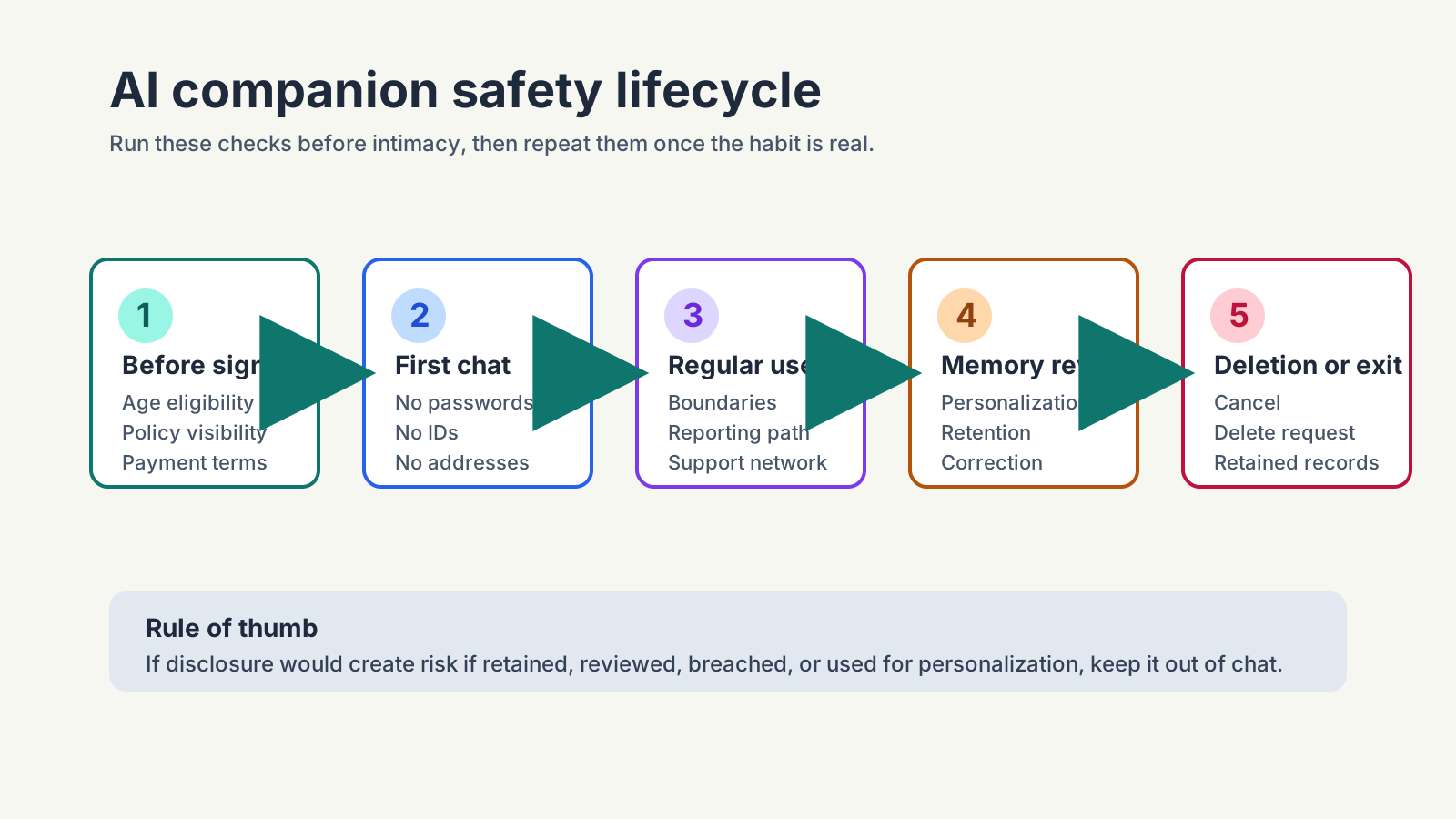
Companion privacy should be evaluated as a lifecycle: what happens before you sign up, during disclosure, during retention and personalization, and when you exit. A 2026 arXiv paper on romantic AI privacy analyzed 2,909 Reddit posts across 79 subreddits and found recurring concerns around entry requirements, intimate sensitivity, perceived surveillance, persistence, and user burden, which supports evaluating privacy across the full lifecycle rather than only at signup.
Before you sign up, read what the app collects. Look for account data, profile data, usage data, chat messages, companion preferences, payment handling, support requests, device data, cookies, and service-provider language. Pleasur.ai's Privacy Policy lists account, profile, payment, communication, usage, device, traffic, cookie, and sensitive companion-preference data categories. Do not assume an intimate product has intimate privacy by default. Source: Pleasur.ai Privacy Policy.
Your first chat is where your personal rule matters most. Decide what you will never share before the companion asks. A good rule is simple: if disclosure would create risk if retained, reviewed, breached, subpoenaed, shown to a partner, or used for personalization, do not put it in the chat.
Your ongoing use is about memory, personalization, and moderation. You want to know whether the app can remember preferences, whether chats or preferences may be used to personalize responses, whether moderation or service providers may access data, and whether you can review or correct what the product remembers. Pleasur.ai's Privacy Policy says data can be used for AI personalization, safety and moderation, service improvement, and legal compliance; the arXiv privacy lifecycle paper supports treating retention and exit as part of the same risk picture. Sources: Pleasur.ai Privacy Policy and arXiv romantic AI privacy lifecycle paper.
Your exit is the part people skip. Before you build a routine, check deletion, retention, export, account closure, and support language. A policy can offer deletion while still retaining some records for legal or business reasons, so avoid promises like “complete deletion” unless the source says exactly that. Pleasur.ai's Privacy Policy says users may request deletion or delete through settings, while some data may be retained where required by law or for legitimate business purposes. Source: Pleasur.ai Privacy Policy.
Use Pleasur.ai's Privacy Policy as a worked example of the clauses to look for: what data is collected, how companion preferences and chat interactions may be used, when moderation or service providers are involved, and what deletion or retention limits apply. That is a policy-reading workflow, not a comparative privacy claim.
- Before signup: ask what the app collects. Inspect the Privacy Policy. Red flag: vague collection categories.
- Your first chat: decide what never enters the conversation. Inspect Terms user-safety language. Red flag: the app requests passwords, IDs, addresses, or financial details.
- Regular use: ask how memory, personalization, and moderation work. Inspect product help, Terms, and Privacy Policy. Red flag: persistent memory with no user-visible control.
- Your exit: ask what deletion, retention, export, and cancellation look like. Inspect account and privacy rights language. Red flag: no deletion or support path.
Privacy controls reduce exposure, but they do not replace emotional boundaries.
Set Emotional Boundaries Before Dependency Forms
A companion can feel supportive without becoming a substitute for human relationships, therapy, or real-world decision-making.
Use the week-three test. Novelty can make almost any companion feel impressive at first. After a few weeks, ask whether the habit still feels healthy: are you using it by choice, or because not using it feels disruptive? Pleasur.ai's related guide, The AI Girlfriend Experience: 90 Seconds to Week Three, is the internal reference for this longer-term evaluation frame.
Watch for secrecy, displacement, and escalation. Privacy is reasonable; secrecy that changes real relationships is different. If your use affects a partner, household, finances, sleep, work, or offline support, the safety question is no longer just “is the app private?” It is “what is this replacing?”
Keep decisions and support networks outside the app. An AI companion may help you reflect, rehearse, or relax, but it should not become the final authority for relationship decisions, health decisions, legal choices, finances, or whether you seek human help. Pleasur.ai's Terms say the platform does not assume responsibility for decisions, behaviors, or consequences arising from AI companion engagement, and JAMA's youth mental-health chatbot discussion treats clinical and ethical safeguards as necessary for mental-health use rather than assuming general chatbots are care providers. Sources: Pleasur.ai Terms of Service and JAMA AI Chatbots and Youth Mental Health abstract.
Step away when the app changes your behavior offline. Warning signs include skipping real obligations, hiding spending, avoiding friends, seeking reassurance you cannot act without, or escalating into content that conflicts with your values or commitments. For relationship-specific boundaries, use Is Having an AI Girlfriend Cheating? An Honest Self-Test as the internal follow-up.
The strongest boundary is knowing what an AI companion should never be used for.
Do Not Use An AI Companion For These Situations
Do not rely on an AI companion for emergencies, self-harm situations, medical, legal, or financial advice, coercive relationship decisions, or professional therapy.
For emergencies or self-harm risk, use real emergency services, crisis resources, qualified care, or trusted people. Do not ask a companion to decide whether you are safe, diagnose you, or manage acute risk. This draft intentionally does not name a jurisdiction-specific hotline because that resource selection needs country-specific publication review.
For medical, legal, financial, or professional advice, treat companion output as unsafe for decision-making. A companion may produce confident language without professional accountability, current context, or enough facts. Use qualified professionals for decisions where errors can harm your health, rights, money, safety, or family.
For therapy, diagnosis, or crisis support, the boundary should be explicit. Pleasur.ai's Terms are a useful example of the boundary to look for: generated content has no guarantee of accuracy or suitability, and users remain responsible for decisions and actions arising from AI companion interactions. JAMA's youth mental-health chatbot discussion supports keeping clinical claims and youth mental-health support behind appropriate clinical and ethical standards. Sources: Pleasur.ai Terms of Service and JAMA AI Chatbots and Youth Mental Health abstract.
For coercive relationship decisions, isolation, or pressure, step away. A companion should not be used to justify manipulation, hide behavior from someone materially affected by it, pressure a partner, or replace support from people who know your real context.
- Emergency or self-harm risk: safer next step is verified emergency or crisis support. Publication should select resources by jurisdiction.
- Medical, legal, financial, or professional advice: safer next step is a qualified professional. Source support: Pleasur.ai Terms of Service and JAMA AI Chatbots and Youth Mental Health abstract.
- Therapy or diagnosis: safer next step is licensed care. Source support: Pleasur.ai Terms of Service and JAMA AI Chatbots and Youth Mental Health abstract.
- Coercive relationship decisions or isolation: safer next step is human support and boundary review. Internal support: Is Having an AI Girlfriend Cheating? An Honest Self-Test.
Once the non-use cases are clear, the adult-content boundary becomes easier to evaluate without turning the article into a panic piece.
Check Age, Adult Content, And Consent Boundaries
Adult AI companion safety starts with age eligibility, clear NSFW expectations, and boundaries that do not normalize secrecy, coercion, or underage content.
Keep teen and adult-use guidance separate. This article is for adults. Youth-facing claims need stronger sourcing and should not be softened into casual advice. Common Sense Media's 2025 assessment said social AI companions should not be used by minors, and Children and Screens recorded a 7-2 Evidence Council vote in favor of requiring parental permission for minors to use AI companions. Sources: Common Sense Media AI companion safety standards and Children and Screens Evidence Council decision.
Verify 18+ requirements and content rules. If an app is adult-oriented, look for clear eligibility language, content boundaries, prohibited content categories, and reporting paths. Pleasur.ai's 18+ framing can be mentioned only as an age-eligibility signal users should verify, not as proof of age-gate effectiveness. Source: Pleasur.ai Terms of Service.
Treat partner consent and secrecy as real-life boundaries. If use affects a partner or agreement, privacy settings do not solve the relationship question. They only affect exposure. The useful question is whether the use fits your actual commitments.
Reject coercive, underage, or non-consensual prompts. Adult-content products should make prohibited categories and safety escalation paths visible enough to inspect. Pleasur.ai's Terms describe restrictions on unlawful use, moderation, and prohibited-content reporting.
The final check is whether the product makes safety signals visible enough for you to evaluate before you commit.
Product Signals That Make Safety Easier To Evaluate
A safer-looking product is not one that claims perfection. It is one that makes boundaries, controls, reporting, memory, and exit paths visible enough to inspect.
Start with visible AI and fictional disclosure. The product should not rely on the user to infer that the companion is synthetic and limited. If the service frames companions as emotionally real, human-like authorities, or substitutes for care, treat that as a red flag. Common Sense Media identified misleading claims of realness as a risk category in social AI companion testing for minors. Source: Common Sense Media AI companion safety standards.
Read the Terms and Privacy Policy before you make it part of your regular use. You are looking for practical signals: age eligibility, entertainment-only limits, sensitive-information warnings, data collection, retention, deletion, service providers, personalization, moderation, cancellation, and payment terms. Built In's 2026 operator-safety guidance similarly frames safer companion products around age-appropriate experiences, moderation, monitoring, and ongoing testing. Sources: Pleasur.ai Terms of Service, Pleasur.ai Privacy Policy, and Built In AI companion safety guidance.
Look for report, block, moderation, and support paths. You do not need a product to promise perfect moderation. You do need an obvious way to respond when content feels unsafe, unwanted, coercive, or outside the product's stated rules. Pleasur.ai's Terms describe content moderation and reporting suspicious behavior to its safety contact. Built In's guidance says flagged or reported problematic interactions require human review. Sources: Pleasur.ai Terms of Service and Built In AI companion safety guidance.
You should check memory transparency and account controls. Companion products often depend on personalization, so vague memory behavior matters. Ask whether you can understand what the app remembers, whether you can correct or delete data, and whether account closure is clear. Pleasur.ai's Privacy Policy includes personalization, access, rectification, erasure, portability, and deletion-request language. Source: Pleasur.ai Privacy Policy.
You should check subscription, cancellation, deletion, and payment clarity. Safety includes exit. If the product makes it easy to start but hard to stop, that is part of the risk profile. Pleasur.ai's Terms say subscriptions automatically renew unless cancelled before renewal and that users may cancel auto-renewal through account settings. Source: Pleasur.ai Terms of Service.
As a worked example, Pleasur.ai gives users public Terms and Privacy pages to inspect, an adult-oriented companion experience, and published product context around creating and chatting with companions and generating images. Treat those as inspectable signals, not proof of perfect safety: the useful question is whether the boundaries, controls, reporting paths, memory behavior, subscription terms, deletion language, and content expectations are visible enough for you to evaluate before you make it part of your regular use.
Before you commit, run a short test. Read the Terms and Privacy Policy. Try a low-risk conversation. Check whether the companion handles contradiction without pressuring you. Count how often it repeats generic support language. Review account settings and cancellation. Then decide whether the experience still looks healthy after the first few weeks.
- AI and fictional disclosure: inspect Terms and onboarding. You pass this check when the synthetic nature is clear. You should treat human-like emotional authority as a red flag.
- Terms and Privacy Policy: inspect public legal pages. You pass this check when boundaries and data language are readable. You should treat vague retention, deletion, or data-use language as red flags.
- Report, block, moderation, support: inspect product UI and help paths. You pass this check when escalation is visible. You should treat the absence of a user-safety path as a red flag.
- Memory and account controls: inspect settings and policy. You pass this check when review or deletion expectations are understandable. You should treat opaque persistent memory as a red flag.
- Subscription and cancellation: inspect checkout and account pages. You pass this check when exit is clear. You should treat upsell confusion or cancellation friction as red flags.
Close by returning to the pre-flight principle: inspect before intimacy forms.
FAQ
Are AI companion apps safe?
AI companion apps can be used more safely when adults verify privacy, boundaries, disclosure, and exit controls first, but they should not be treated as therapy, crisis support, or professional advice. Sources: Pleasur.ai Terms of Service, JAMA AI Chatbots and Youth Mental Health abstract, and Common Sense Media AI companion safety standards.
What should I check before using an AI companion?
You should check age eligibility, AI and fictional disclosure, privacy and data use, sensitive-information limits, memory and deletion controls, emotional boundaries, adult-content rules, reporting, and payment/account controls. This draft's first checklist section is designed for a featured-snippet answer.
What information should I not share with an AI companion?
You should not share passwords, financial details, government IDs, home addresses, private third-party data, or anything you would not want retained, reviewed, disclosed, or used for personalization. Pleasur.ai's Terms specifically warn against disclosing sensitive personal information, including financial details, physical addresses, passwords, or government identification numbers. Source: Pleasur.ai Terms of Service.
Can an AI companion replace therapy?
No. An AI companion should not replace therapy, crisis care, diagnosis, or professional medical advice. Use qualified care and verified emergency or crisis resources when health or safety is at stake. Sources: Pleasur.ai Terms of Service and JAMA AI Chatbots and Youth Mental Health abstract.
Are AI companions safe for teens?
This article is for adults. Teen and minor guidance requires stronger youth-safety sourcing, and the draft should cite youth-safety sources rather than generalize from adult companion use. Common Sense Media's 2025 assessment said social AI companions should not be used by minors, and Children and Screens recorded a 7-2 Evidence Council vote in favor of parental permission for minors using AI companions. Sources: Common Sense Media AI companion safety standards and Children and Screens Evidence Council decision.
Conclusion
The safest time to evaluate an AI companion is before the first intimate disclosure and again before the app becomes routine.
A good checklist does not ask whether a companion app is perfect. It asks whether you can inspect privacy, emotional boundaries, non-use cases, adult and consent boundaries, visible product controls, and exit paths before you make it part of your regular use. You should read the product's Terms and Privacy Policy, run the checklist, and then repeat it after the first few weeks. For a longer habit check, use The AI Girlfriend Experience: 90 Seconds to Week Three as the follow-up frame.